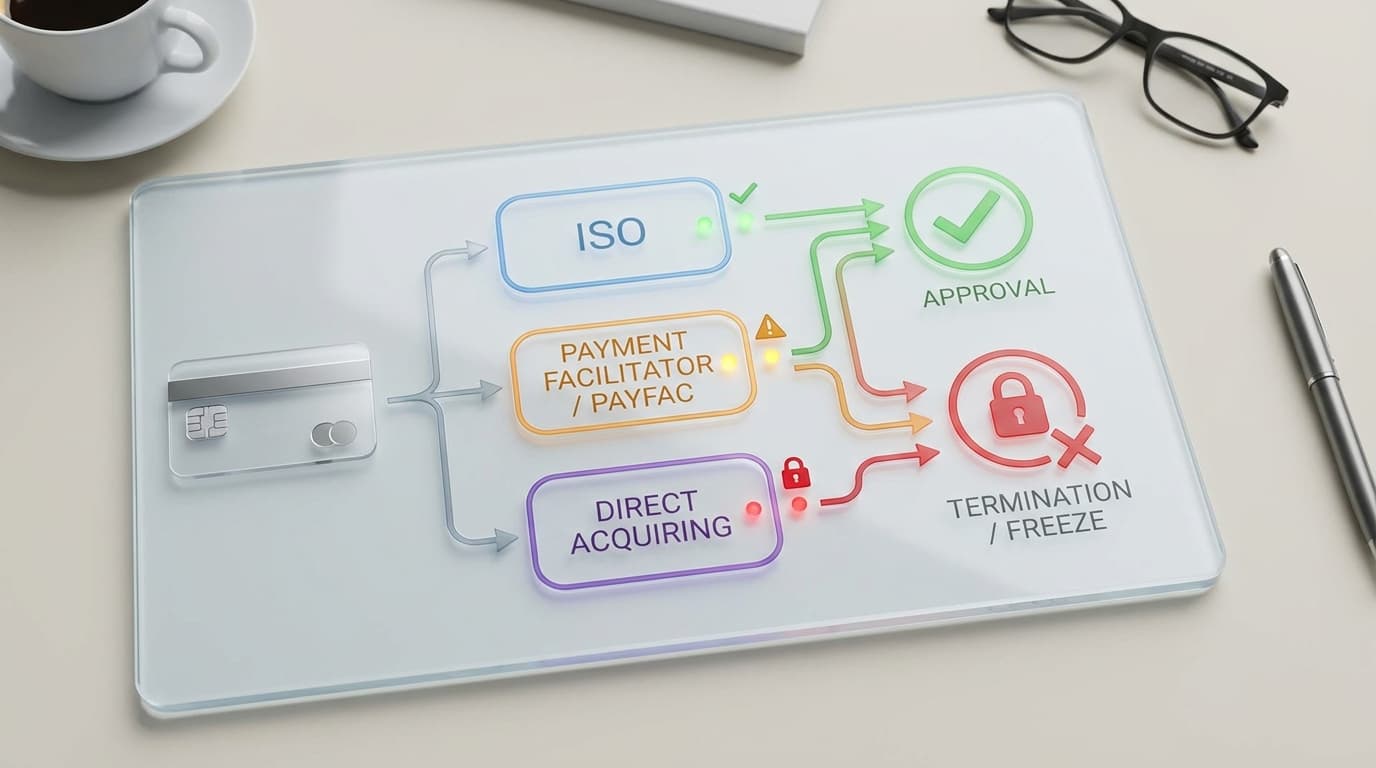
A high-risk merchant account for peptide stores is a card-processing relationship where an acquiring bank reviews the business before issuing a merchant identification number (MID), instead of placing it inside a broad platform’s master account. That individual review takes longer and comes with tighter terms, but it is the practical path for a catalog presented openly as research use only (RUO). The goal is not to hide the category. It is to give the bank a consistent, reviewable business.
“High risk” does not mean your business is automatically fraudulent or illegitimate. It means the acquiring bank expects a higher level of scrutiny, a greater possibility of disputes, and more card-network oversight than it would for an ordinary apparel or home-goods store.
Your checkout is not durable payment infrastructure unless the acquiring bank understands what you sell. A processor account that survives only because nobody has reviewed the catalog yet is not a processing strategy.
Why are peptide stores treated as high risk?
The high-risk label comes from the banking chain, not from a single website platform deciding that it dislikes peptides. Card networks set operating standards. Acquiring banks—the banks that accept card transactions for merchants—carry financial and compliance exposure when a merchant produces excessive disputes or violates network rules. Processors and payment platforms then decide which categories they are willing to support.
Mastercard’s Business Risk Assessment and Mitigation program, known as BRAM, is part of the backdrop. BRAM places responsibility on acquirers to identify and manage higher-risk merchant activity. Mastercard’s 2026 guidance update, GLB 11691.1, specifically brings research peptides and nutraceuticals into sharper focus for acquiring institutions.
Visa applies similar pressure through its merchant-risk and dispute-monitoring framework. Visa’s Acquirer Monitoring Program, commonly called VAMP, gives acquiring banks a direct reason to watch dispute patterns, fraud signals, and merchant behavior across their portfolios. Earlier Visa monitoring terminology, including VDMP, still appears in processor conversations, but the operating reality is the same: an acquirer must be able to explain why it accepted a merchant and how it monitors that account.
These network frameworks do not function as one-click approval or denial tools by themselves. They shape the risk environment around the acquiring bank. That distinction matters, because the real decision point for most peptide sellers is whether an acquirer is willing to review and support the business at all.
For research-use-only peptide commerce, underwriters typically focus on whether the store’s presentation is consistent. An RUO label on one product page does not carry much weight if collection pages, ad copy, FAQs, or customer-facing materials point in a different direction. Product naming, labeling, certificates, policies, billing descriptors, and support practices all become part of the underwriting file.
Underwriting is less interested in a polished homepage than in whether every part of the business tells the same factual story.
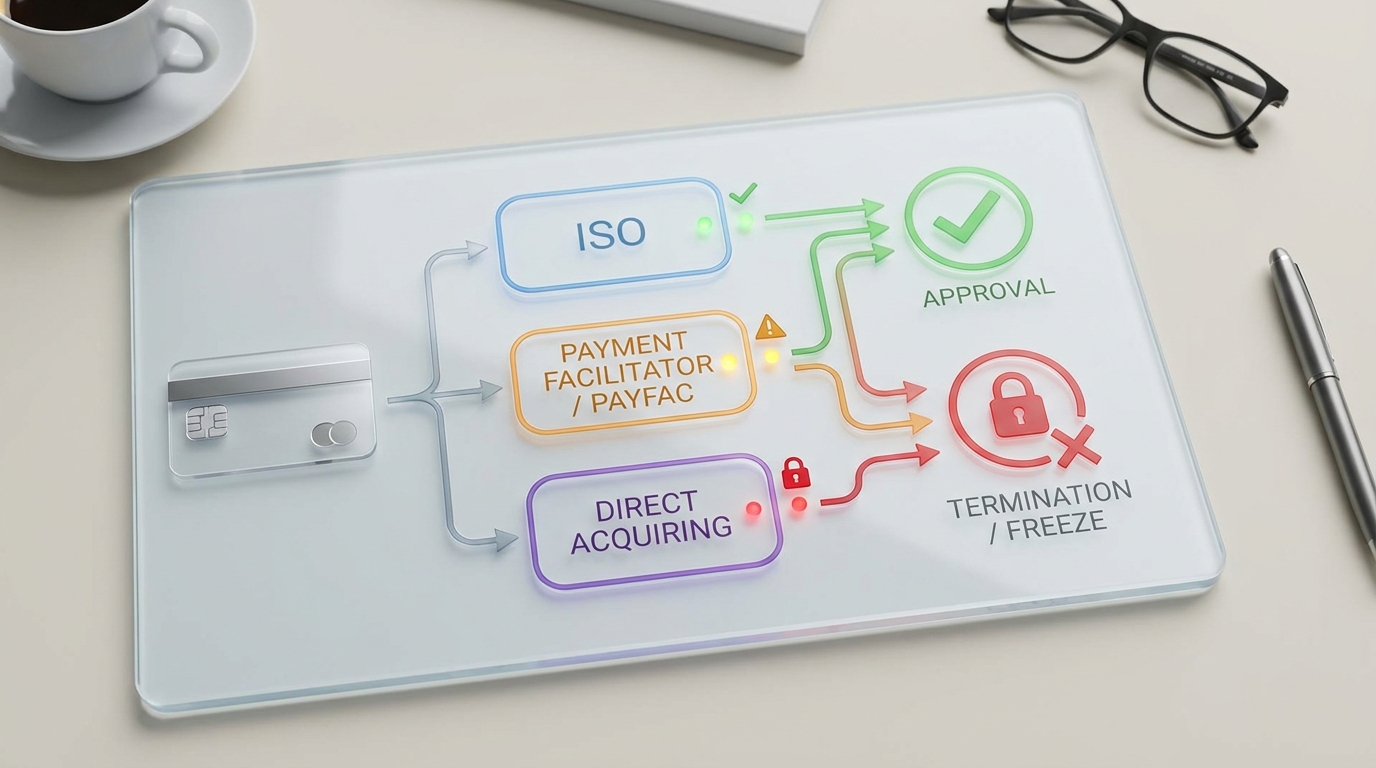
Why do Stripe, PayPal, Square, and similar platforms become unstable for peptide stores?
Stripe, PayPal, Square, and many similar providers operate as payment facilitators, usually shortened to PayFacs. A payment facilitator places many businesses under its own master merchant account. This gives small merchants fast onboarding, but it also means the platform has to keep its overall portfolio inside its acquiring-bank and card-network risk limits.
Stripe’s Prohibited and Restricted Businesses policy, PayPal’s Acceptable Use Policy, and Square’s prohibited-goods rules restrict broad categories of regulated, controlled, or higher-risk products. Those policies are not a promise of individualized underwriting. A store may open an account, process for a short period, and then receive a review after transaction data, website scans, customer complaints, or internal risk monitoring identify the product category.
The notice is often brief: the account violates policy, payments are paused, and funds may be held under the provider’s agreement while liability is reviewed. There is often little useful detail and no meaningful appeal path for a category the platform has already decided not to support.
This is why a clean-looking store alone does not solve the problem. The issue is not whether the product pages look professional. The issue is whether the payment platform’s sponsor bank has accepted the category in the first place.
What is the difference between a PayFac, an ISO, and a direct acquiring relationship?
These terms get thrown around by sales reps as if they mean the same thing. They do not. Knowing the relationship model tells you who actually owns the risk decision, who can change your terms, and who can help when a review lands.
- Payment facilitator: A PayFac onboards merchants as sub-merchants beneath its master account. It is fast for ordinary ecommerce, but it retains broad discretion to suspend or close accounts. This model is generally fragile for openly marketed RUO peptide catalogs.
- Independent sales organization: An ISO is a payment-services intermediary that places merchants with acquiring banks and processors. A specialized ISO can submit a peptide merchant application to an acquiring relationship that is willing to review the category individually. The ISO does not erase bank risk, but it can coordinate underwriting and explain the bank’s requirements.
- Direct acquiring relationship: In a direct arrangement, the merchant contracts with the acquiring bank without an ISO between them. This can provide more direct control and communication, but direct access is usually reserved for businesses with substantial volume, operating history, and a risk profile the bank already understands.
A payment gateway is separate from all three. The gateway is the technical service that sends card data from your checkout to the processor. It is not automatically your merchant account, your acquiring bank, or your approval. A gateway can work perfectly while the underlying merchant account is under review.

For most peptide operators, the practical relationship is a specialized ISO paired with an acquiring bank and processor willing to underwrite the business on its actual catalog. Managed infrastructure—the self-hosted Saleor backend and custom Next.js storefront route we build at RUO Commerce—is separate from that banking relationship, but owning the storefront makes it easier to present stable, consistent documentation when a processor asks for it.
What do underwriters actually review in a peptide merchant application?
High-risk underwriting is manual because the underwriter is trying to understand both the business and the transaction risk. A merchant application commonly includes identity and ownership records, business-registration documents, bank-account verification, expected processing volume, and prior processing statements when the merchant has them.
The website review is equally important. Underwriters commonly inspect the live storefront, not just screenshots sent with an application. They look at product names, collection pages, product labels, terms of sale, shipping language, returns language, customer-service contact details, and the checkout flow.
- RUO presentation: “Research use only” should appear consistently across product pages, labels, catalog navigation, and store policies where relevant.
- COA availability: A certificate of analysis, or COA, is a batch-specific laboratory document reporting analytical results such as identity or purity testing. Displaying a clear COA library gives reviewers a way to see that product documentation is organized rather than improvised.
- Accurate product copy: Product descriptions should stay factual: compound name, format, storage information, lot or batch references where used, purity documentation, and research labeling.
- Clear support and policies: Visible customer-service contact methods, shipping terms, refund terms, and order-status processes help an underwriter understand how disputes will be handled.
- Billing descriptor clarity: The billing descriptor is the name that appears on a cardholder’s statement. It should clearly connect to the business the customer recognizes from the checkout page.
A vague descriptor creates avoidable disputes. A customer who sees an unfamiliar charge may file a dispute even when the order was delivered correctly. That kind of dispute is often called friendly fraud, but the operational fix is still straightforward: make the business name, receipt, support email, and card statement descriptor recognizable as the same company.
How long does high-risk underwriting take?
Expect a real review, not instant self-service approval. A clean application with a complete site, clear ownership records, and an acquiring path that already supports the category can move in days. Applications with inconsistent product presentation, incomplete documents, unclear supplier arrangements, or prior processing issues can take weeks or stop entirely while the underwriter asks follow-up questions.
“Instant approval” language deserves careful reading. A sales rep may mean that they can submit an application immediately, not that an acquiring bank has completed its review or assigned a usable MID. Ask what stage is actually complete: lead intake, ISO review, processor review, bank approval, gateway configuration, or live transaction capability.
A MID is the merchant identification number tied to the card-processing account. It matters because it identifies the merchant relationship inside the acquiring system. Before treating a new account as operationally stable, operators commonly confirm the acquiring bank, processor, MID, gateway connection, billing descriptor, reserve terms, and dispute-notification process.

What fees and reserves should a peptide merchant expect?
High-risk pricing is not just a higher card-processing rate. The agreement may include transaction fees, monthly account fees, gateway fees, chargeback fees, account-maintenance fees, and currency or cross-border fees where applicable. The important number is the total cost of accepting a settled order, not the headline percentage on the sales sheet.
A rolling reserve is the portion of each card settlement that the processor temporarily holds to cover potential refunds, disputes, or chargebacks. The agreement should explain the reserve percentage, the reserve cap if one exists, the holding period, and the release schedule. A reserve is not inherently a sign that the processor is dishonest; it is a risk-control tool. But vague reserve language can create serious cash-flow problems for a growing store.
Read the termination and funding-hold sections with the same attention you give the rate sheet. Also ask how disputes are reported, who receives retrieval requests, and how quickly the merchant can submit evidence. A low rate is not a bargain if the account has no clear support path when a review begins.
The MATCH list is another term operators should understand. MATCH stands for Mastercard Member Alert to Control High-risk Merchants. It is a database used by acquiring institutions during underwriting. A processor closure does not automatically mean a MATCH listing, but a MATCH record can make future payment applications materially harder. That is one reason to avoid misrepresenting products, business history, or processing volume on an application.
What should a peptide operator do before applying?
Prepare the store before the application, not after the first decline. Underwriters notice mismatches quickly: an RUO label in the footer but not on products, COAs that do not match catalog batches, a business name that differs from the checkout receipt, or policies copied from an unrelated store.
- Make the live catalog, product labels, COA library, and customer-facing policies consistent with the RUO business model.
- Keep business-formation records, owner identification, bank verification, supplier records, and any prior processing statements organized and current.
- Use a billing descriptor that customers can connect to the store and customer-support contact information.
- Review processor agreements for reserve mechanics, chargeback fees, termination language, and funding timelines before relying on projected cash flow.
- Keep a second operational record of orders, tracking, customer correspondence, refund activity, and COA references so a dispute response does not become a scavenger hunt.
The durable approach is boring in the best possible way: disclose the category honestly, keep product presentation disciplined, use an acquiring relationship that has actually reviewed the business, and treat dispute prevention as an operating function rather than a payment-processing afterthought.
Note: This article describes common industry practices in research-use-only peptide commerce. It is not legal advice, and it does not guarantee platform, processor, or regulatory outcomes. Operators should consult qualified counsel for their specific situation.