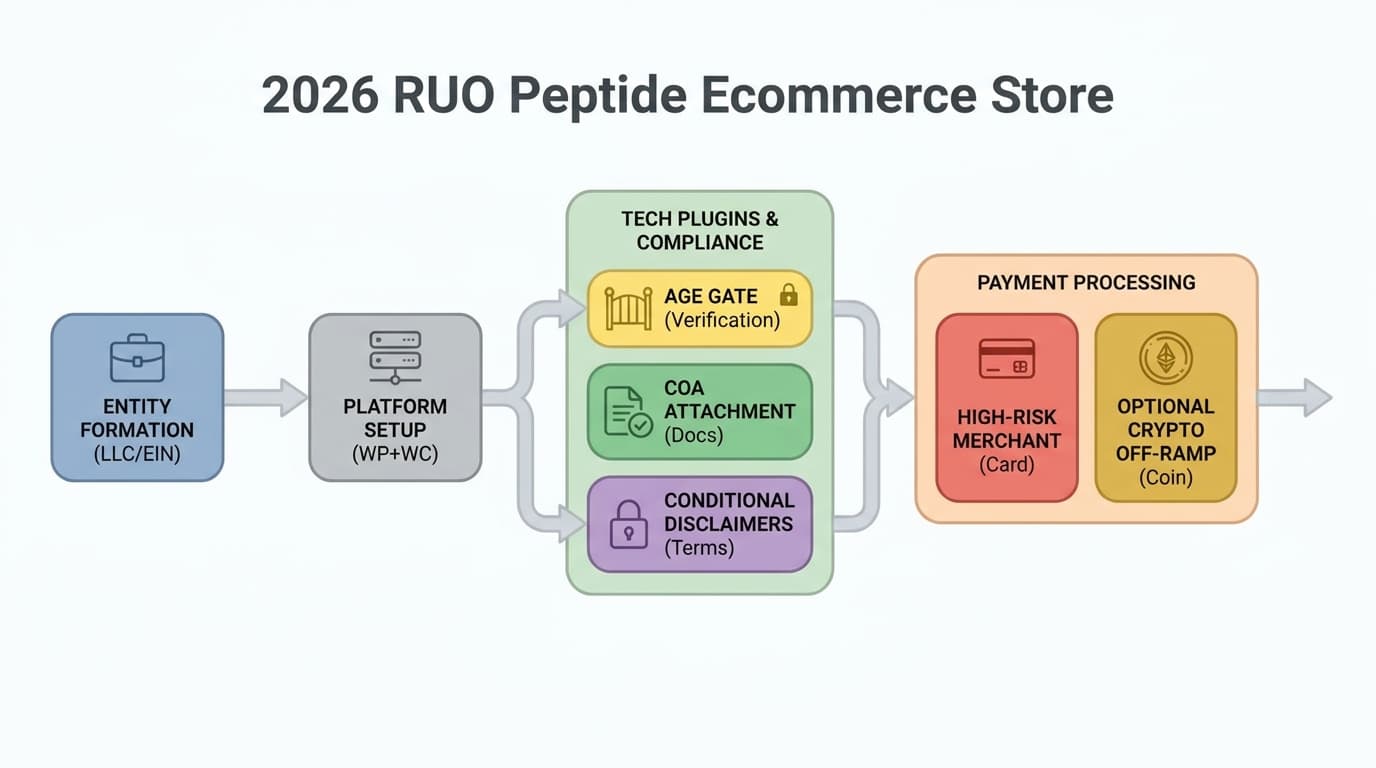
To launch an RUO (research-use-only) peptide ecommerce store in 2026, build the company file, product record, and payment application before you try to market the catalog. Form and document the entity, choose infrastructure you control, prepare batch-level records, and submit an honest high-risk merchant application. A self-hosted storefront can reduce platform dependence, but it does not remove acquiring-bank, card-network, hosting, or regulatory review. Plan in months, not weekends.
The hard truth is that the first transaction is usually not blocked by your product photography or your theme. It is blocked by incomplete business documents, an unclear supply chain, product copy that creates review friction, or a payment application submitted before the website is ready for underwriting.
What does “launching an RUO peptide store” actually involve?
RUO means research use only: products are presented as laboratory research materials, with no consumer-use, therapeutic, diagnostic, cosmetic, performance, or administration language. That positioning has to be consistent across the website, product labels, customer support replies, email flows, invoices, packaging inserts, and social accounts. An RUO label by itself is not a legal shield; reviewers look at the full context of how the product is marketed and sold.
A real launch has five connected parts: an operating entity, a documented catalog and supplier relationship, a storefront you can control, payment rails that understand the category, and an internal process for keeping every public touchpoint aligned. A polished site with no merchant account is not a launch. A merchant account application with a thin, unfinished website is usually not one either.
Infrastructure does not make a difficult category disappear. It makes the category legible to the people reviewing it.
Which entity documents do processors and banks typically review?
High-risk payment underwriting is a Know Your Business review, often shortened to KYB. The processor, its sponsoring acquiring bank, and sometimes additional risk teams want to know who owns the company, where funds settle, what is being sold, and whether the business website matches the application.
An acquiring bank is the bank in the card-payment chain that sponsors the merchant account. A merchant ID, or MID, is the account identifier assigned to a merchant for card processing. These are not interchangeable with a normal business bank account. Your bank receives settlement funds; the acquiring relationship enables card acceptance.
Operators commonly assemble the following before entering underwriting:
- Articles of Organization or Articles of Incorporation showing entity formation.
- An Operating Agreement or equivalent ownership document showing who controls the business.
- An EIN, or Employer Identification Number, used for tax and banking identification in the United States.
- A dedicated business bank account in the entity’s name.
- A business address, business contact details, and any applicable local or state business-registration materials.
- A concise description of the catalog, fulfillment model, refund process, and intended sales channels.
- Supplier invoices, testing records, or other documentation that supports the products shown on the site.
Do not treat this as paperwork to invent after the application is submitted. Reviewers compare names, addresses, ownership information, website policies, and bank details. Inconsistencies create more friction than a straightforward explanation of the business model.
Entity formation, tax treatment, licensing, labeling, and regulatory classification depend on your facts and jurisdiction. This is where qualified counsel and an accountant earn their keep. The operational point is simpler: build a document file that accurately reflects the company operating the store.
Why do hosted ecommerce platforms create risk for peptide catalogs?
Hosted ecommerce platforms give you speed, but they also control the account, checkout, data access, and often the payment relationship. That means a policy decision can affect more than checkout. It can affect your storefront, order history, customer service workflow, and payout timing at the same time.
Shopify’s Acceptable Use Policy is the clearest example of this platform-level exposure in the category. Stripe’s Restricted Businesses page similarly makes clear that certain product categories require special review or are not supported. Neither document is a promise that a particular RUO catalog will remain approved simply because it is live today.
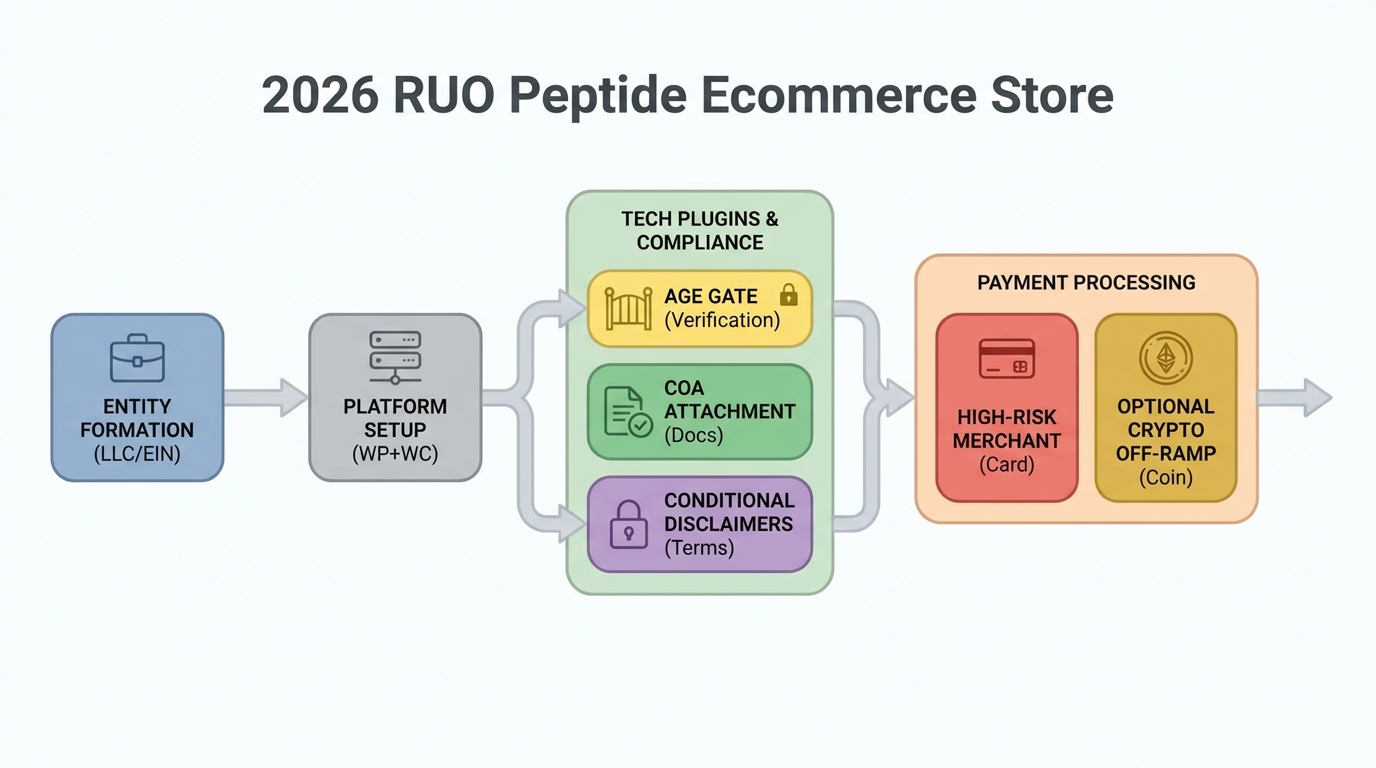
The familiar failure pattern is blunt: the email says the store violates an acceptable-use policy, provides little category detail, and leaves the operator trying to recover order data and customer communication at the worst possible moment. That is not a reason to hide what you sell. It is a reason to avoid building the entire business on an account you do not control.
“Self-hosted” does not mean unreviewed. It means the storefront is not the same single point of failure as the payment account.
What storefront stack is realistic in 2026?
A self-hosted architecture separates the storefront from the hosted-platform account. WooCommerce on WordPress remains a common route because it is widely supported, flexible, and familiar to many operators. It can be a practical choice when you need a conventional catalog, documented product pages, and a checkout that can accommodate processor-required disclosures.
A more custom route uses a self-hosted Saleor backend with a custom Next.js storefront. That approach provides stronger control over storefront behavior, product-data architecture, integrations, and customer experience, but it requires more technical ownership. Managed infrastructure—this is what we build at RUO Commerce—trades a recurring operating cost for a self-hosted Saleor and Next.js stack the client controls, while shifting more of the deployment and maintenance burden off the operator.
The trade-off is not “cheap versus expensive.” It is “simple today versus controllable later.” A hosted builder can be faster for a standard catalog. A self-hosted stack asks you to own hosting, updates, backups, security, and integrations, either internally or through an operator. For an RUO catalog, that ownership can matter when you need to change checkout language, document handling, or payment connections without waiting for a platform exception.
The practical question is not which stack looks most impressive in a demo. It is which stack your team can actually maintain when underwriting asks for wording changes, when a batch document needs to be replaced, or when a payment connection has to be swapped without taking the whole storefront down.
What should every RUO peptide product page show?
A Certificate of Analysis, or COA, is a laboratory document associated with a batch that may identify the material tested and report analytical information such as the batch identifier and stated purity or assay result. A COA is not decorative content. It is part of the operating record behind the product listing.
Product-page presentation commonly includes a prominent RUO designation, the product name and format, storage and handling information supplied by the manufacturer or testing documentation, the relevant batch number, and a clear route to the matching COA. The batch shown to the customer should match the document linked from the page. If inventory changes batches, the page and fulfillment process need to change with it.

If the page shows one batch and the shelf holds another, you do not have a copywriting problem. You have an inventory-control problem. That mismatch can spill into refund requests, support disputes, and underwriting questions about whether the website accurately reflects the goods being sold.
Operators also commonly maintain visible shipping, refund, privacy, and terms pages, plus a clear business contact method. These pages do not make a store immune from review. They make the operation easier for a reviewer to understand and easier for customers to navigate.
FDA warning letters involving peptide sellers routinely focus on product claims that position materials as unapproved drugs. In April 2026, the agency issued warning letters to online peptide sellers that paired RUO disclaimers with health, wellness, disease, or performance claims. The practical operating discipline is to remove that language everywhere, including abandoned-cart emails, affiliate copy, social captions, support macros, and image text. A clean product page does not help if the marketing archive tells a different story.
Just as important, reviewers do not look only at labels. They look at the full sales context. If the storefront, support process, and order pattern read like consumer retail rather than laboratory supply, the RUO framing becomes harder to defend operationally.
What do high-risk processors actually check?
High-risk processors evaluate more than the legal entity. They often review the live domain, product pages, checkout flow, policies, fulfillment timeline, customer support contacts, and the consistency of your application narrative. An age gate, checkout acknowledgement, and clear RUO language may be requested by an underwriter, but requirements vary by processor and acquiring bank.
No processor name should be treated as a shortcut or a pre-approval. The real decision sits with underwriting and the acquiring bank, and that decision can change as your catalog, sales pattern, or website changes. What helps most is a site that is complete, internally consistent, and easy to review.
A rolling reserve is a portion of card sales held temporarily by the processor to cover refunds and chargebacks. It is a normal part of many higher-risk merchant agreements, not a surprise afterthought. The agreement may also include higher processing costs, transaction monitoring, limits on monthly volume, or a requirement to notify the processor before materially changing the catalog or website. Reserve size and release timing are risk-based, not fixed industry constants.
Read the merchant agreement carefully before treating card processing as “solved.” Ask how reserves are calculated, when they are released, what triggers additional review, how chargebacks are handled, and whether the processor expects prior approval for new products or material changes to copy.
Crypto payment options may reduce dependence on card rails, but they create separate operational questions around customer support, reconciliation, wallet security, tax records, and conversion of funds for business expenses. Many stores explore more than one payment method because relying on a single rail leaves little room when a provider changes its risk appetite.

What does a realistic month-by-month launch timeline look like?
The timeline below is a planning sequence, not a promise of approval or a legal roadmap. Underwriting and business-registration timing can extend it.
- Month one: form the operating foundation. Establish the entity, organize ownership and banking documents, choose the catalog model, and collect supplier, batch, label, and COA records. Write the basic store policies and define who owns customer support, fulfillment, inventory updates, and documentation review.
- Month two: build the reviewable storefront. Configure the self-hosted platform, connect the domain, build product templates, add policy pages, and establish a process for matching each live batch to its COA. Test order notifications, inventory status, refund handling, and access controls before inviting traffic.
- Month three: submit for payment underwriting. Apply with a payment provider whose risk team is willing to review the category. Submit the entity file and direct the reviewer to a finished, publicly accessible site. Keep the application description aligned with the catalog and do not add unsupported claims while the review is underway.
- Month four: operate toward the first transaction. Once payment access is available, run controlled checkout testing, verify settlement instructions, confirm fulfillment handoffs, and monitor support requests. Treat early orders as an operations test: product records, batch matching, shipping communication, refunds, and chargeback prevention all matter more than a launch-day traffic spike.
What usually slows this sequence down is not design work. It is missing ownership documents, unclear supplier records, unfinished policy pages, or a site that says one thing in the application and another thing in the catalog. That is why I tell founders to build for review first and promotion second.
How should you budget for the first year?
Budgeting starts with categories, not fantasy revenue projections. Fixed costs can include entity maintenance, accounting, domain management, hosting, security, storefront development, and product-document management. Variable costs can include testing, labels, packaging, fulfillment, payment processing, reserves, refunds, chargebacks, and customer support.
The most expensive mistake is often rebuilding the store after a hosted-platform or payment failure. The second is launching a catalog before documenting the inventory behind it. Spend early effort on reusable product templates, clean COA handling, a consistent support policy, and a payment file that tells the same story as your website.
Cash planning matters as much as cost planning. If part of your sales volume is held back in reserve, that is not spendable operating cash on day one. A store can look healthy on gross sales and still feel cash-constrained if the payment terms, refund exposure, and fulfillment costs were not modeled honestly.
Your first transaction is not the finish line. It is the first proof that your entity, inventory records, checkout, payment rail, and fulfillment process can operate together without contradicting one another.
The practical order is straightforward: establish the company record, document the catalog, build an ownable storefront, make the site reviewable, then approach payment underwriting with the finished operation in view. That route is slower than opening a generic online store, but it is far more honest about what RUO peptide commerce requires.
Note: This article describes common industry practices in research-use-only peptide commerce. It is not legal advice, and it does not guarantee platform, processor, or regulatory outcomes. Operators should consult qualified counsel for their specific situation.