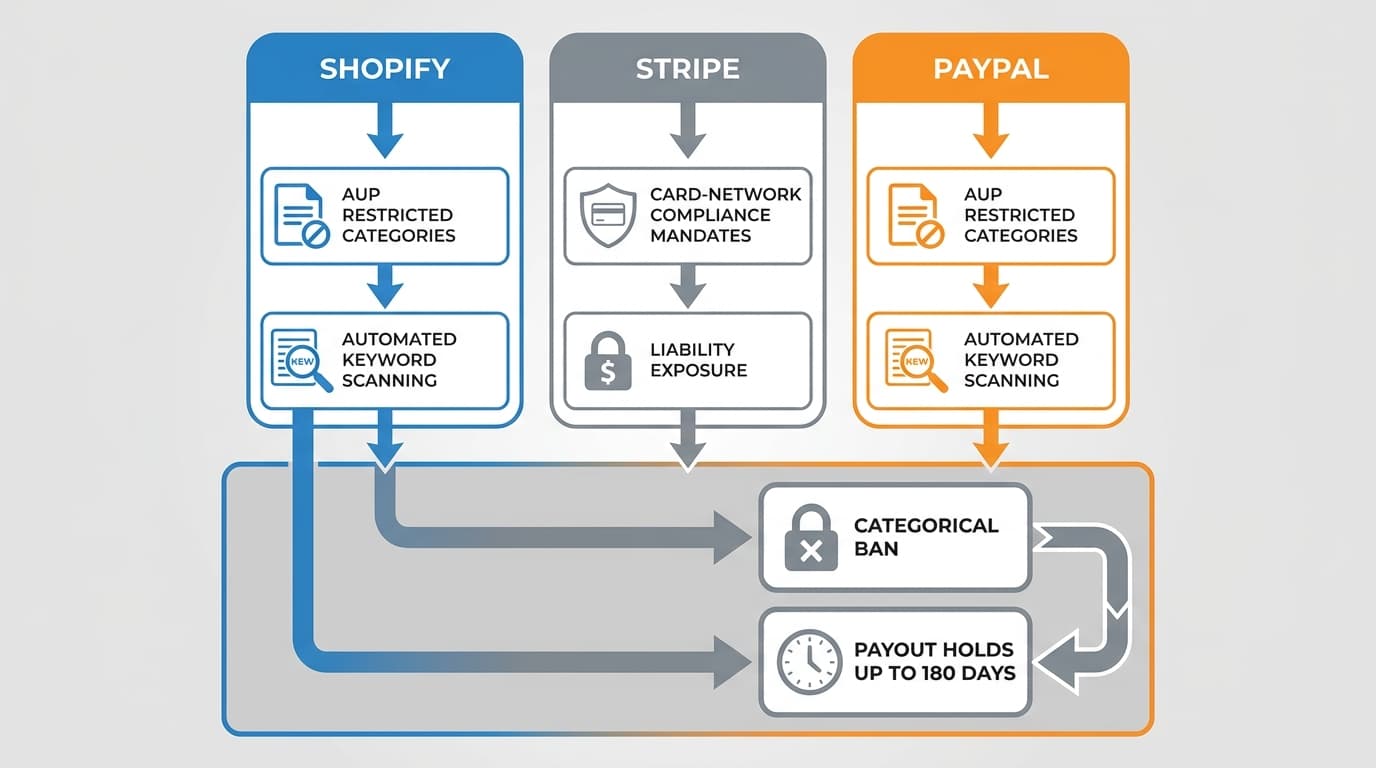
Shopify, Stripe, and PayPal ban or restrict many peptide stores because their policies commonly classify research-use-only (RUO) peptides as research chemicals, unapproved pharmaceutical products, or regulated goods with elevated payment risk. An RUO label and a certificate of analysis (COA), meaning a batch test document, can improve store documentation, but they do not override a platform’s acceptable-use policy or a processor’s risk decision.
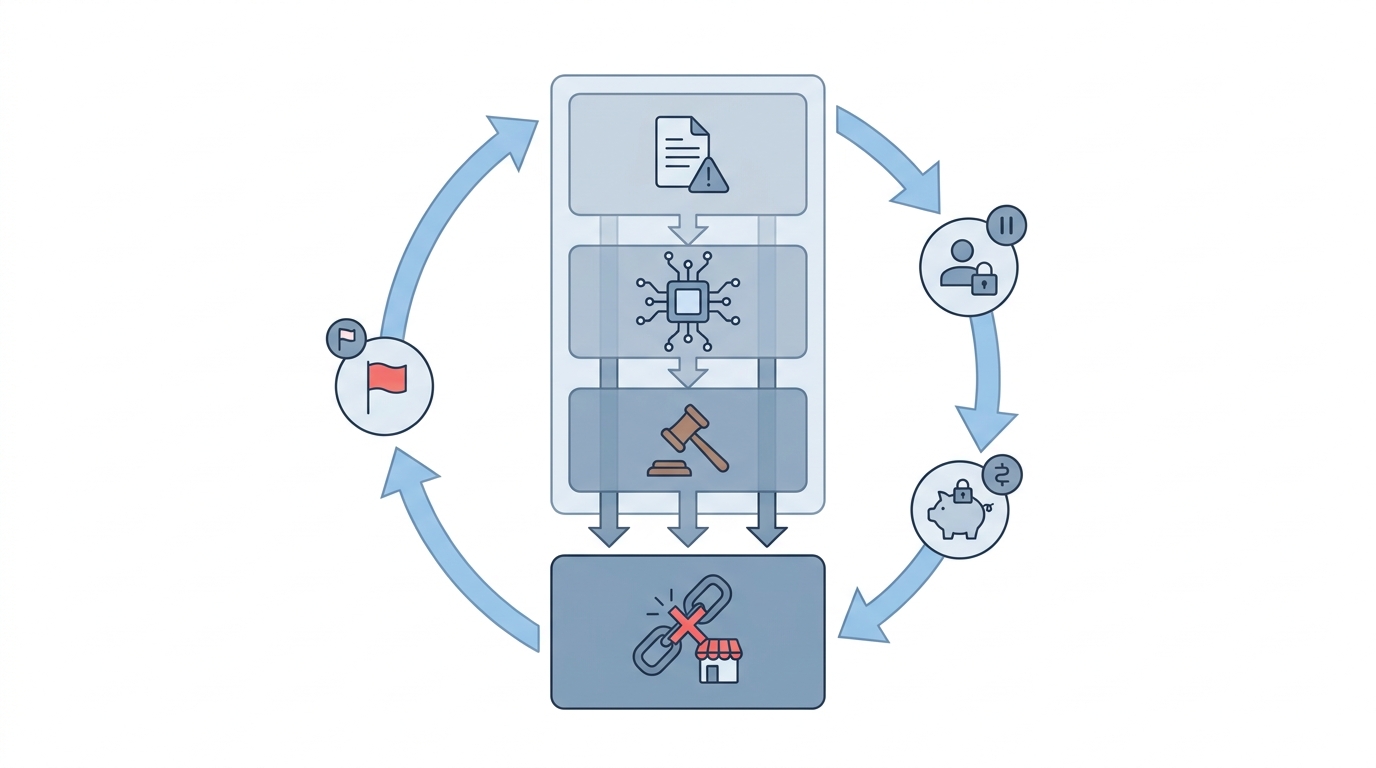
The email usually says some version of “your store violates our Acceptable Use Policy,” with little useful detail and a payout hold attached. That is not a random moderation event. It is the visible result of a chain involving the storefront platform, its payment partners, the acquiring bank, and card-network rules.
A peptide storefront can look professionally built and still be outside a mainstream platform’s risk appetite. The issue is not whether the site has a polished theme. It is whether every company in the transaction chain is willing to support that product category.
Why do peptide stores get banned from Shopify and Stripe?
The short answer is category classification. Stripe’s Restricted Businesses list explicitly identifies “peptides, research chemicals, and other toxic, flammable and radioactive materials” as prohibited activity. That language matters because it is a categorical restricted-business rule, not a request for a better homepage or a cleaner checkout flow.
The product prohibition can be categorical even when enforcement timing is not identical for every account. Some stores are flagged early, while others draw review after order volume, transaction patterns, or other risk signals accumulate. Either way, the underlying problem is the same: the category itself sits outside the processor’s normal risk appetite.
Stripe is both a payment technology provider and part of the acquiring chain for many businesses. An acquiring bank is the financial institution that enables a merchant to accept card payments. If a product category falls outside the acquiring bank’s risk appetite, a merchant account can be declined, paused, or terminated even when the store itself is operating normally from a technical perspective.
Shopify creates a separate but related problem. Shopify is a commerce platform, while Shopify Payments is its integrated payment product. A store can be reviewed at the platform level, the payment level, or both, and those reviews do not always happen at the same time. Shopify’s Acceptable Use Policy and payment rules restrict products that are regulated, restricted by law, require special licensing, or create heightened safety and liability concerns. Trust and Safety reviewers may classify peptide catalogues within those restricted categories.
That is why a founder can spend weeks on a Shopify build, turn on Shopify Payments, receive a few orders, and then lose access with little notice. The business did not necessarily fail at ecommerce. It selected a platform-and-payment combination whose policy structure was not built to support its catalogue.
Shopify can be a storefront decision, a payment decision, and a data-ownership decision at the same time. Treating it as only a website builder is how operators get trapped.
Why does PayPal also flag RUO peptide transactions?
PayPal’s Acceptable Use Policy separately restricts categories that include certain drugs, controlled substances, unapproved products, and products that present consumer-safety risks. Research chemical language, product names, order descriptions, support emails, and transaction metadata can all contribute to how a business is assessed.
PayPal is not simply a checkout button. It is a financial account with its own monitoring systems, reserves, dispute controls, and account limitations. A merchant may find that a PayPal account is limited after activity begins, even if the PayPal button was technically easy to install and early transactions settled normally.
For peptide operators, the hard lesson is that adding PayPal as a backup does not create an independent safety net. If the underlying category is restricted under PayPal’s policy, the account remains exposed to review. A second mainstream processor can create a second point of failure rather than genuine redundancy.
What do platforms and processors actually review?
Reviews are rarely limited to one product title. A reviewer or underwriting team typically looks at the entire commercial presentation: product pages, collection names, searchable metadata, lab reports, refund terms, support language, shipping policies, chargeback patterns, ownership documents, and the way a merchant describes its inventory during onboarding.
RUO means research-use-only. It is a product-positioning and labeling designation used in the research supply market. It does not act as a universal permission slip for a storefront platform, payment processor, acquiring bank, or card network. The same is true for a COA. A COA documents batch testing details such as identity, purity, lot number, and analytical method; it is valuable product documentation, but it does not change a processor’s restricted-business list.
- Product titles and category labels, including compound names and “research chemical” terminology.
- Product copy that drifts beyond factual research-catalogue language.
- Images, labels, and downloadable documents that conflict with the site’s stated RUO positioning.
- Checkout descriptors, transaction metadata, invoices, and customer-service correspondence.
- Missing corporate records, unclear supplier relationships, or incomplete batch documentation.
- Refund, shipping, and contact pages that appear generic, inconsistent, or incomplete.
- Dispute rates and refund patterns that make an acquiring bank view future card losses as more likely.
The fastest way to create review friction is inconsistency. A footer may state “for research use only,” while a collection page, blog post, or support reply uses language that tells a different story. Underwriters and platform reviewers look for whether the business presentation is coherent, not whether one disclaimer exists somewhere in the footer.
What are rolling reserves, payout holds, and the MATCH list?
Payment risk is not limited to a simple approval or denial. A processor may impose a rolling reserve, meaning it withholds a portion of each card sale for a defined period to cover refunds and chargebacks. A reserve is not a fine, but it affects working capital immediately. It can turn an apparently healthy sales month into a cash-flow problem.
Payout holds are more severe. When an account is limited or terminated, processors may retain funds for a period under their terms to account for potential disputes, refunds, and chargebacks. In this category, operators commonly see hold periods in the 90- to 180-day range rather than immediate release. Operators should read the actual payout and reserve clauses in every agreement before relying on settlement timing for inventory purchases, fulfillment expenses, or supplier deposits.

The MATCH list is Mastercard’s Member Alert to Control High-Risk Merchants system. It is a record used by acquiring institutions when evaluating certain terminated merchant relationships. Placement is not automatic whenever a store is closed, but a termination for a processor-rule violation can affect later underwriting. This is why hiding the real catalogue from an application is such a damaging idea: it can turn a difficult underwriting conversation into a merchant-integrity problem.
A related term is MID, short for merchant ID. A MID is the account identifier tied to a card-processing relationship. If a prior termination becomes part of the underwriting record around that relationship, getting a later MID can become harder even if the next website looks cleaner.
Do not build your operating plan around “getting away with it” until the next review. Build around whether the processor has knowingly assessed the actual business.
What storefront routes are realistic for RUO peptide operators?
Mainstream all-in-one platforms are attractive because setup is quick: hosting, themes, checkout, and payments arrive in one package. That simplicity is real, but it also means one policy decision can remove several layers of the business at once. If the platform or its payment product restricts the catalogue, the operator has limited control over the timing or outcome of a review.
A self-hosted commerce stack separates storefront infrastructure from payment processing. That can mean a WooCommerce installation, a custom storefront connected to an ecommerce backend, or another self-managed architecture. The advantage is ownership of the storefront code, product data, hosting relationship, and payment-gateway integration. The trade-off is operational responsibility: security updates, monitoring, backups, integrations, and technical support do not disappear just because the platform logo does.
Managed self-hosted infrastructure is the middle ground for operators who need ownership without personally maintaining every server and deployment. This is the route we build at RUO Commerce: a self-hosted Saleor backend and custom Next.js storefront that the client owns, while we operate the infrastructure. It does not make a restricted processor acceptable or guarantee an underwriting result. It separates your store from a single hosted-platform policy decision.
Specialized high-risk payment providers are another distinct layer. “High-risk” does not mean unregulated, hidden, or consequence-free. It means the provider has a risk model designed for categories that mainstream processors decline. Underwriting can be slower, documentation requests can be heavier, fees and reserves may be less favorable, and approval remains the provider’s decision.
What documentation reduces processor review friction?
Serious underwriting starts with a business that can be described consistently and documented cleanly. Operators commonly prepare ownership and corporate records, bank information, supplier invoices or agreements, batch-specific COAs, fulfillment details, shipping and refund policies, product labels, and a clear explanation of their catalogue.
Product pages should function like a research catalogue, not like vague promotional landing pages. A useful page commonly includes the compound name, format, stated quantity, batch or lot reference where applicable, storage and shipping handling information, a link to the relevant COA, and clear RUO labeling. Copy should remain factual and should not make health, therapeutic, cosmetic, performance, or consumer-use claims.
A consistent catalogue also helps operationally. When a customer asks for a COA, the support team should be able to locate the matching batch record. When a fulfillment partner receives an order, product labels and packing records should align with the storefront. When an underwriter opens the site, the business description should match the application. Those are basic controls, but they are often the difference between a review that can proceed and one that stops at the first contradiction.
What should happen after a Shopify, Stripe, or PayPal shutdown?
First, preserve what you still control: product records, order exports, customer-service history, supplier documentation, COAs, shipping records, and accounting data. A hosted platform account is not a backup strategy. Store data should exist outside the platform before any suspension occurs.
Second, read the termination or limitation notice closely and keep the record. It may identify the relevant policy section, settlement timeline, dispute process, or documents connected to the review. Avoid treating a new domain, a different business name, or concealed product language as a recovery plan. That approach compounds risk and can make future underwriting harder.
Finally, separate the rebuild into the right sequence: catalogue and documentation first, storefront ownership second, payment underwriting third, and launch only after the pieces match. The slow part is usually not installing a new theme. It is aligning the business, the product presentation, and the payment relationship honestly enough that no one in the chain is surprised by what you sell.
If there is one lesson here, it is simple: platform convenience and payment permission are not the same thing. Treat them as separate decisions from the start, and you will make better choices about risk, ownership, and how exposed your business really is.
Note: This article describes common industry practices in research-use-only peptide commerce. It is not legal advice, and it does not guarantee platform, processor, or regulatory outcomes. Operators should consult qualified counsel for their specific situation.